Abuja Serviced Apartment Prices 2026: What 50 Brands Actually Charge
Median nightly prices by unit size, district and type from 50 branded Abuja serviced apartments, and why the top of the market sells direct.

By Anthony OnuorahFounder & CEO, Corinth Group
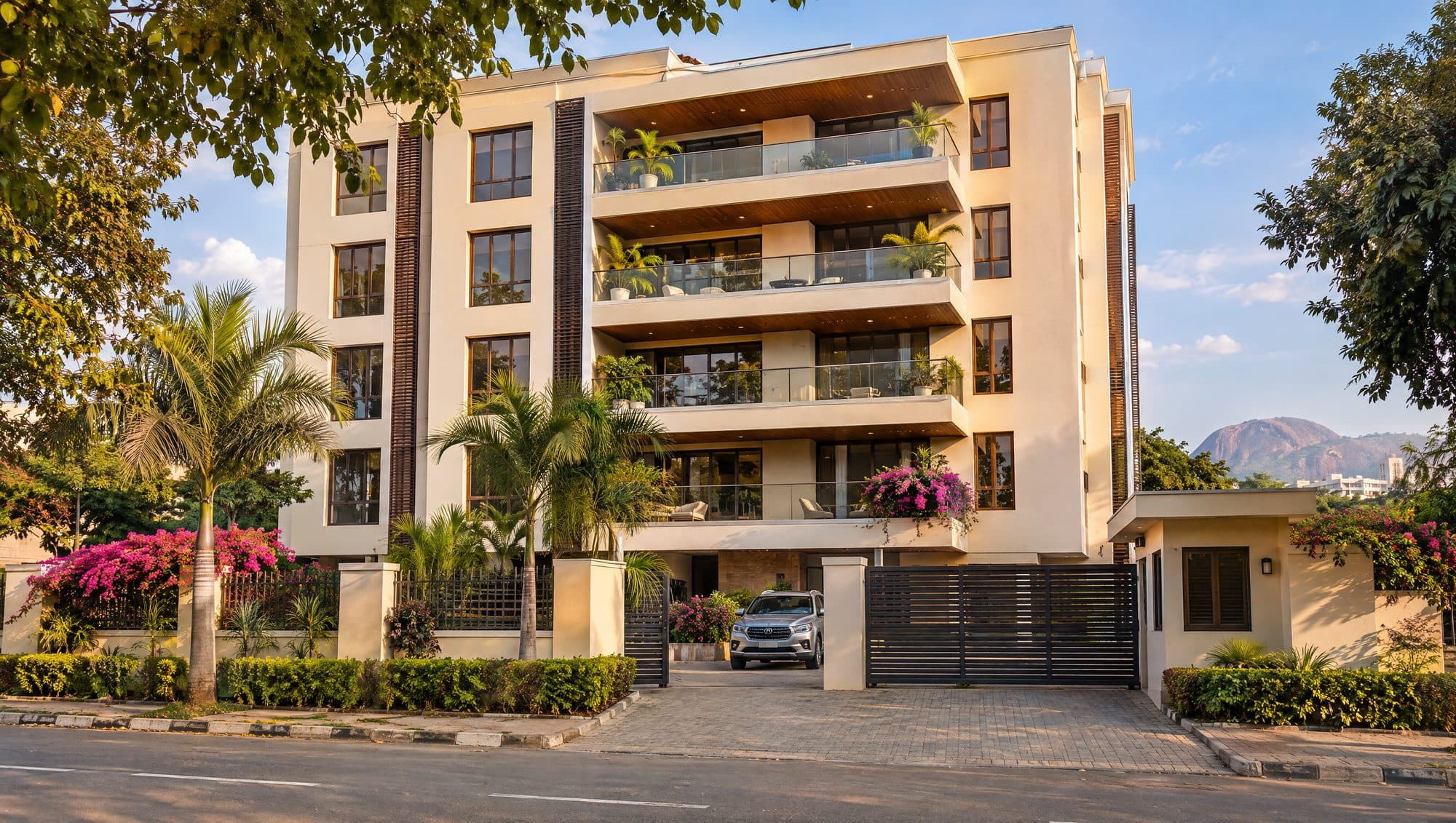
Corinth Group market note. Prices collected 21 to 28 October 2026. Next edition: May 2027.
A one-bedroom serviced apartment in Abuja costs a median of about ₦109,000 a night. A two-bedroom costs about ₦187,000 and a three-bedroom about ₦212,000. Those are the medians across 50 branded serviced apartments and aparthotels we priced in late October 2026. The medians are the least interesting part of the data, though. Within each unit size, the most expensive quarter of the market charges 50% to 80% more than the cheapest quarter, and the reasons are mostly operational rather than architectural.
This note sets out what we found, how we collected it, and what it means for owners pricing a unit and for guests budgeting a stay.
Key findings
- One-bedroom: median ₦108,900 per night (31 brands). The middle half of the market sits between ₦95,000 and ₦160,600.
- Two-bedroom: median ₦186,700 (29 brands), middle half ₦140,000 to ₦250,000.
- Three-bedroom: median ₦211,900 (26 brands), middle half ₦158,900 to ₦250,000.
- The second bedroom is worth far more than the third. Moving from one to two bedrooms adds about ₦78,000 a night at the median. Moving from two to three adds only about ₦25,000.
- Wuse 2 is the most expensive district for one- and two-bedroom units, with a two-bedroom median of about ₦332,000 among the six brands we priced there.
- The premium end of the market sells direct.Where we could only find a brand’s price on a booking platform, the two-bedroom median was ₦152,600 (9 brands). Where the brand quoted us through its own rate card, website or Instagram, it was ₦227,500 (20 brands).
How we collected these prices
We built a shortlist of 52 Abuja serviced-apartment and aparthotel brands and collected prices for 50 of them between 21 and 28 October 2026. Sources were public booking pages (Booking.com, Hotels.ng, Hotels.com, Trip.com, Airbnb, Google Hotels), operators’ own websites, rate cards operators sent us, and their Instagram accounts. Where an operator quoted a range, we used the midpoint. Where a range was so wide that the midpoint meant nothing (for example ₦90,000 to ₦350,000 for “a one-bedroom”), we excluded it.
Each property was classified as a serviced apartment (a self-contained flat with its own kitchen, in a building run as a hospitality operation), an aparthotel (apartments plus hotel services such as a front desk and restaurant), a hotel with apartment units, or a single home listed on Airbnb.
Three cautions:
- These are quoted nightly prices for specific dates in November 2026 to January 2027, not achieved averages. Operators discount and surcharge. December rates in particular will be higher.
- The sample is branded, professionally presented supply. It excludes spare rooms, individually listed flats with no brand, and long-let rents.
- Small samples. Some district cells contain six or seven brands. We suppress any cell with fewer than four and say so.
That third point matters when you compare our figures with the data tools. AirDNA reports an average daily rate of about $50 for Abuja short-term rentals over the 12 months to around August 2026, with occupancy around 42%[1]. AirROI reports $58 and 27% for May 2025 to April 2026[2]. Those tools average every active Airbnb listing in the city, from a room in a shared flat to a penthouse. Our survey covers the branded end of the market only. That is why our medians are higher. It is also why owners who price a premium unit against a data-tool average usually underprice it.
Abuja serviced apartment prices by unit size
| Unit size | Brands | Lower quartile | Median | Upper quartile | Lowest | Highest |
|---|---|---|---|---|---|---|
| 1-bedroom | 31 | ₦95,000 | ₦108,900 | ₦160,600 | ₦40,000 | ₦375,000 |
| 2-bedroom | 29 | ₦140,000 | ₦186,700 | ₦250,000 | ₦98,000 | ₦550,000 |
| 3-bedroom | 26 | ₦158,900 | ₦211,900 | ₦250,000 | ₦87,900 | ₦525,000 |
The jump from one to two bedrooms (about 72% at the median) is far larger than the jump from two to three (about 13%). Part of this is composition: six of the 26 three-bedroom prices come from individually listed homes on Airbnb, which price below branded operators. But even among branded serviced apartments the third bedroom earns relatively little. Most demand comes from one to four guests: couples, solo business travellers and small families. A three-bedroom often competes for the same booking as a two-bedroom.
For owners choosing what to build or furnish, two-bedroom units look like the strongest earner per square metre in this data. If you already own three-bedroom units, letting them as a two-bedroom with the third room locked off on unsold nights is worth testing.
Prices by district
| District cluster | 1-bed median (brands) | 2-bed median (brands) | 3-bed median (brands) |
|---|---|---|---|
| Wuse 2 | ₦168,000 (6) | ₦332,000 (6) | ₦238,000 (6) |
| Maitama, Asokoro and Guzape | ₦160,000 (7) | ₦208,000 (6) | Fewer than 4 |
| Central (Utako, Jabi, Wuye, Garki, Durumi, Jahi) | ₦96,000 (7) | ₦200,000 (7) | ₦250,000 (9) |
| Outer and growth (Katampe, Life Camp, Dawaki, Gwarinpa, Lugbe, Apo) | ₦97,000 (10) | ₦140,000 (7) | ₦180,000 (6) |
Wuse 2 commands the highest one- and two-bedroom prices. It sits close to the business district, embassies, restaurants and nightlife, and corporate guests pay for being near all of it. Maitama, Asokoro and Guzapeare the diplomatic and high-net-worth districts; one-bedroom prices are close to Wuse 2’s, but the two-bedroom median is lower in our sample. The central districts are where three-bedroom stock is strongest, often in newer estates with pools and gyms. Outer and growth districts price at a discount for distance from the centre, but they are where much of the new supply is being built.
Treat the district medians as indicative. Six or seven brands per cell is enough to see a pattern, not to price a specific unit.
Serviced apartments, aparthotels and single homes
| Type | 1-bed median (brands) | 2-bed median (brands) | 3-bed median (brands) |
|---|---|---|---|
| Serviced apartment | ₦100,000 (18) | ₦156,000 (16) | ₦250,000 (13) |
| Aparthotel | ₦160,000 (7) | ₦232,000 (8) | ₦213,000 (4) |
| Single home on Airbnb | Fewer than 4 | Fewer than 4 | ₦170,000 (6) |
Aparthotels charge more for smaller units because the guest is paying for a front desk, daily housekeeping and often a restaurant. At three bedrooms the order flips. Larger serviced apartments are bought by families and groups who care more about space and a kitchen than about hotel services.
The real story: same size, very different prices
Within each unit size, the upper quartile is roughly 50% to 80% above the lower quartile. Two two-bedroom flats in the same city, both professionally presented, can differ by more than ₦100,000 a night. Our data points to two drivers beyond location.
The premium end sells off-platform. For 27 of the 50 brands, the price came from the operator directly: a rate card sent to us, their website, or an Instagram reply. For 25, we could only find it on a booking platform. The two-bedroom median for the direct group was ₦227,500 against ₦152,600 for the platform-only group. That is a correlation, not proof of cause. But it fits what we see in the market: established premium operators in Abuja build demand through Instagram, WhatsApp, repeat corporate guests and referrals, and use booking platforms for overflow.
Review volume does not track price here.The median brand in our sample had 23 platform reviews, and 21 of 47 had fewer than 20. Two-bedroom units with 50 or more reviews actually had a lower median price (₦162,000) than those with fewer (₦228,000), because the most reviewed properties are often mid-market booking-platform regulars. In Abuja’s premium segment, guests rely on Instagram, word of mouth and the brand itself, not on platform review counts.
The lesson for a new owner is uncomfortable. If you rely on booking platforms alone, you are competing in the mid-market band whatever your finish. Reaching the upper quartile takes a direct channel and a reputation guests can check outside the platforms. The Abuja Operating Standard sets out what that reputation is built from.
Breakfast, deposits and other things that change the price
- Breakfast is rare. Only 3 of the 50 brands stated that breakfast was included. Guests comparing an aparthotel with a hotel should budget for it.
- Caution deposits are common and usually refundable. Ask how and when they are returned.
- Length-of-stay discounts for weekly and monthly stays appear on many rate cards. Corporate and NGO guests booking seven nights or more should always ask.
- Watch for add-ons after the headline price: service charges, VAT and occasionally power surcharges. Compare all-in prices.
What to expect in December and January
December demand in Abuja comes from returning families, diplomatic and government calendars, weddings and events, concentrated in Maitama, Wuse and Asokoro[3]. Expect quoted prices to rise for mid-December to early January.
Lagos gives a warning about how far to push. In December 2025, short-let operators there reported strong diaspora-led demand[4], but reports also described guests pushing back on festive prices and some switching to hotels[5]. Bookings dropped sharply after the first week of January 2026[6]. Raise rates for real demand, but not beyond what the property’s reputation can defend. Our December pricing guide sets out a method.
If you own a serviced apartment in Abuja
Three questions to ask of your current pricing:
- Are you priced against comparable value, or against the cheapest listing on your street?
- Where are your bookings coming from? If almost all arrive through booking platforms, you are probably selling in the mid-market band and paying commission on guests who would have booked direct.
- Do you price by length of stay? One-night stays cost a full turnover. Weekly and monthly stays fill the calendar and cut costs.
We will benchmark your unit against this data set, free. Request a price benchmark or read how we run short-let and serviced apartment management in Abuja.
Frequently asked questions
How much is a serviced apartment in Abuja per night?In late October 2026, the median branded serviced apartment cost about ₦109,000 a night for one bedroom, ₦187,000 for two and ₦212,000 for three. Prices range from about ₦40,000 to over ₦500,000 depending on size, location and operator.
What is the average price of a two-bedroom shortlet in Abuja?The median two-bedroom in our survey was ₦186,700 a night, and the middle half of the market sat between ₦140,000 and ₦250,000. Wuse 2 was higher, with a median around ₦332,000.
Which area of Abuja has the most expensive serviced apartments?Wuse 2 had the highest one- and two-bedroom medians in our sample, followed by Maitama, Asokoro and Guzape.
Why are Abuja serviced apartments more expensive than Airbnb averages suggest?Airbnb data tools average all active listings, including rooms and unbranded flats. Our figures cover professionally run, branded serviced apartments only.
Are serviced apartment prices higher in December?Usually, yes. Demand from returning families, events and the diplomatic calendar pushes prices up from mid-December to early January.
Do Abuja serviced apartments include breakfast?Rarely. Only 3 of the 50 brands we priced stated that breakfast was included.
Method note and how to cite
Prices were collected from public and operator-supplied sources for 50 Abuja brands between 21 and 28 October 2026, using midpoints of quoted ranges and excluding ranges too wide to be meaningful. Quartiles use the inclusive method. Individual property prices are not published. Suggested citation: Corinth Group, “Abuja Serviced Apartment Prices 2026”, November 2026.
References
- AirDNA, Abuja short-term rental market overview, trailing 12 months to around August 2026. www.airdna.co/vacation-rental-data/app/ng/default/abuja/revenue
- AirROI, Abuja, Federal Capital Territory Airbnb market data, May 2025 to April 2026. airroi.com/airbnb-data/nigeria/federal-capital-territory/abuja
- The Guardian Nigeria, “How Detty December reshaped real estate sector”. guardian.ng/property/real-estate/how-detty-december-reshaped-real-estate-sector
- Nairametrics, “Lagos short-stay apartments record strong diaspora-led demand during 2025 Detty December”, 9 January 2026. nairametrics.com/2026/01/09/lagos-short-stay-apartments-record-strong-diaspora-led-demand-during-2025-detty-december
- Nigeria Housing Market, “Detty December costs push visitors back to hotels in Lagos”. www.nigeriahousingmarket.com/real-estate-news-nigeria/detty-december-costs-push-visitors-back-to-hotels-in-lagos
- Nairametrics, “Lagos short-let profits under pressure as competition intensifies”, 5 August 2026. nairametrics.com/2026/08/05/lagos-short-let-profits-under-pressure-as-competition-intensifies